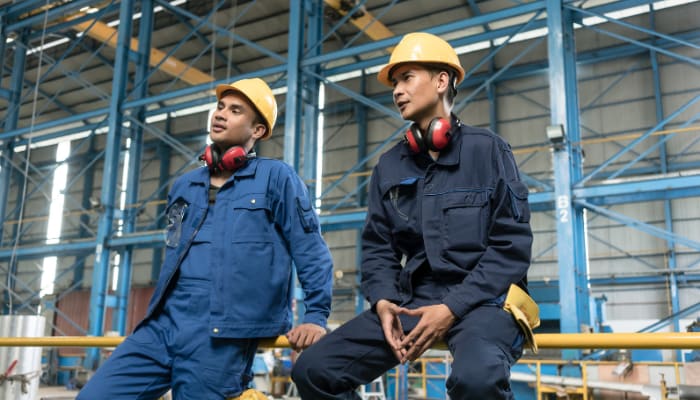
Nowadays, many people immediately associate a successful future with an office job. Especially if you've completed havo or vwo, it almost seems like a given that you'll go on to study and eventually end up behind a laptop somewhere. A job filled with meetings, deadlines, reports, strategies, and long days in front of a screen. But that picture doesn't fit everyone.
Being smart or successful doesn't mean you have to spend five days a week from 9 to 5 racking your brain in front of a laptop. For some people, that works well. They enjoy analysing, making plans, writing, or solving problems primarily in their head. But there are also plenty of people who thrive much more when they can make, do, build, repair, move, or create something. That's not less smart. It's simply a different way of working.
Why an office job isn't automatically better
An office job is often seen as "higher" or "more successful". As if working with your head is better than working with your hands. But in practice, that's far too simplistic. An office job can be interesting, but also exhausting. You sit still a lot, often work behind screens, and sometimes only see the results of your work much later. You spend your time on emails, meetings, documents, analyses, or plans. For some people, that gives them energy. For others, it feels like being stuck all day.
That's why it's important not only to look at what others consider successful, but at how you work best. Do you get energy from thinking, planning, and analysing? Or rather from doing, moving, and seeing direct results? That difference says a lot about what suits you.
Practical work is much broader than people think
When people think of practical work, they often immediately think of construction or technical trades. Plumber, carpenter, electrician. Those are good examples, but practical work is much broader than that.
A baker also works with their hands. You make products that people buy and eat that same day. That requires a feel for timing, precision, and quality. A hairdresser or barber works with technique, style, and people. You see direct results and have a lot of personal contact. A personal trainer works with movement, health, and motivation. You help people become stronger, fitter, or more confident.
Creative professions also fall into this category. Think of photographer, videographer, furniture maker, tattoo artist, florist, chef, interior builder, or make-up artist. You create something tangible or visible. Something someone can experience directly.
And then of course there are the practical professions that literally keep society running: plumbers, roofers, electricians, pavers, mechanics, and other skilled tradespeople. Without these people, very little works. No houses, no heating, no electricity, no roads, no maintenance. That kind of work will always be needed. Even in a world with AI.
Why practical work is becoming increasingly valuable
Many office jobs are changing rapidly. AI is increasingly able to take over or speed up tasks. Think of writing texts, analysing data, producing reports, handling customer service, or carrying out simple administrative tasks. That doesn't mean all office jobs will disappear. But it does mean that a lot of work behind a laptop is changing.
Practical work is less vulnerable to this. An AI can't repair a roof, cut a hairstyle, bake bread, replace a tap, or run a sports session where someone needs personal guidance. Technology can help, but the work itself remains human and physical.
That's exactly why practical professions can be very future-proof. Especially when there are few people who want to learn the trade. Less supply and high demand often means better chances of earning well, particularly if you later work as a freelancer or start your own business.
Examples of practical work to consider
If you're torn between an office job and practical work, it helps to look beyond the standard images. If you enjoy being creative, you might think about photographer, videographer, hairdresser, barber, tattoo artist, chef, baker, or interior builder. You work with style, taste, image, materials, or people. The result is visible.
If you enjoy being physically active, work as a personal trainer, gym teacher, gardener, paver, or sports instructor might be interesting. You're in motion, work with people or outdoors, and don't sit behind a screen all day.
If you enjoy solving problems, professions like plumber, electrician, car mechanic, installation engineer, or carpenter might suit you well. You need to think practically, find causes, and implement solutions.
If you prefer structure, communication, and analysis, an office job might be a better fit. Think of marketing, HR, finance, communications, data analysis, project management, administration, or policy. You can get a lot of satisfaction from that too, as long as it matches the way you work. So it's not about better or worse. It's about fitting or not fitting.
The biggest mistake is choosing based on status
Many people choose a course of study or a job because it "sounds good". Because parents think it's sensible. Because friends are also going on to study. Or because an office job feels like the safe, successful route. But status is a poor reason to choose something.
If sitting still all day, long meetings, and screen work make you unhappy every day, it doesn't matter much how impressive your job title sounds. The reverse is equally true: if you actually love planning, strategy, and intellectual work, you shouldn't force yourself towards practical work just because it seems "nicely free". A good choice doesn't start with what sounds impressive, but with what gives you energy.
Quiz: does practical work or an office job suit you better?
Answer the questions with:
Yes = 2 points
Somewhat = 1 point
No = 0 points
Add up your points at the end.
- Do you enjoy seeing direct results from your work?
- Do you get restless from sitting behind a laptop all day?
- Do you learn faster by doing something than by reading about it?
- Do you enjoy making, repairing, building, or creating things?
- Do you get energy from being physically active or working with your hands?
- Do you prefer your work to be concrete and visible?
- Does the idea of learning a real trade that people can directly benefit from appeal to you?
- Do you prefer working practically rather than theoretically?
- Is it important to you to have variety in your working day?
- Does the idea of perhaps working as a freelancer or with your own clients appeal to you?
Results
0 – 7 points: an office job probably suits you better
You probably get more energy from thinking, analysing, organising, or communicating than from practical work. That doesn't mean you can never do anything creative or active, but an office job may be a better fit for the way you work. In that case, look especially at directions like marketing, communications, finance, HR, data, policy, project management, or administration. What's important is that you choose an office job that matches your interests, because office work can vary enormously.
8 – 14 points: both could be interesting
You're somewhere in the middle. Maybe you enjoy practical work, but you also want to think, plan, or work with clients. In that case, hybrid professions often work well. Think of roles like photographer, personal trainer, social media creator, interior adviser, entrepreneur, project manager in construction, estate agent, event manager, or technical adviser. These combine doing with thinking. For you, it's smart to try things out. Shadow someone for a day, take a short course, get a part-time job, or talk to people who are already doing the work. That way you'll find out more quickly what gives you energy.
15 – 20 points: practical work probably suits you better
There's a good chance you thrive more in work where you're active, making things, moving, or seeing direct results. That doesn't mean you're not smart. It means your talents are probably more practical in nature. Take a look at professions like hairdresser, baker, chef, photographer, personal trainer, gardener, carpenter, plumber, electrician, mechanic, interior builder, or gym teacher. In these kinds of trades especially, you can achieve a great deal if you become truly good at what you do.
Success doesn't look the same for everyone
A good job isn't automatically a job behind a laptop. And practical work is not a plan B. The best choice is work that fits the way you think, learn, and get energy. For one person, that's an office role with strategy and analysis. For another, it's a practical profession where you make something, solve problems, or make a direct difference to someone. Success isn't the same as working with your head all day. Success is doing work that you can get really good at, that people need, and that you don't have to force yourself through every single day.

 Rogier Rijnja